
France Télévisions introduces an IA agent at RG Lab 2024
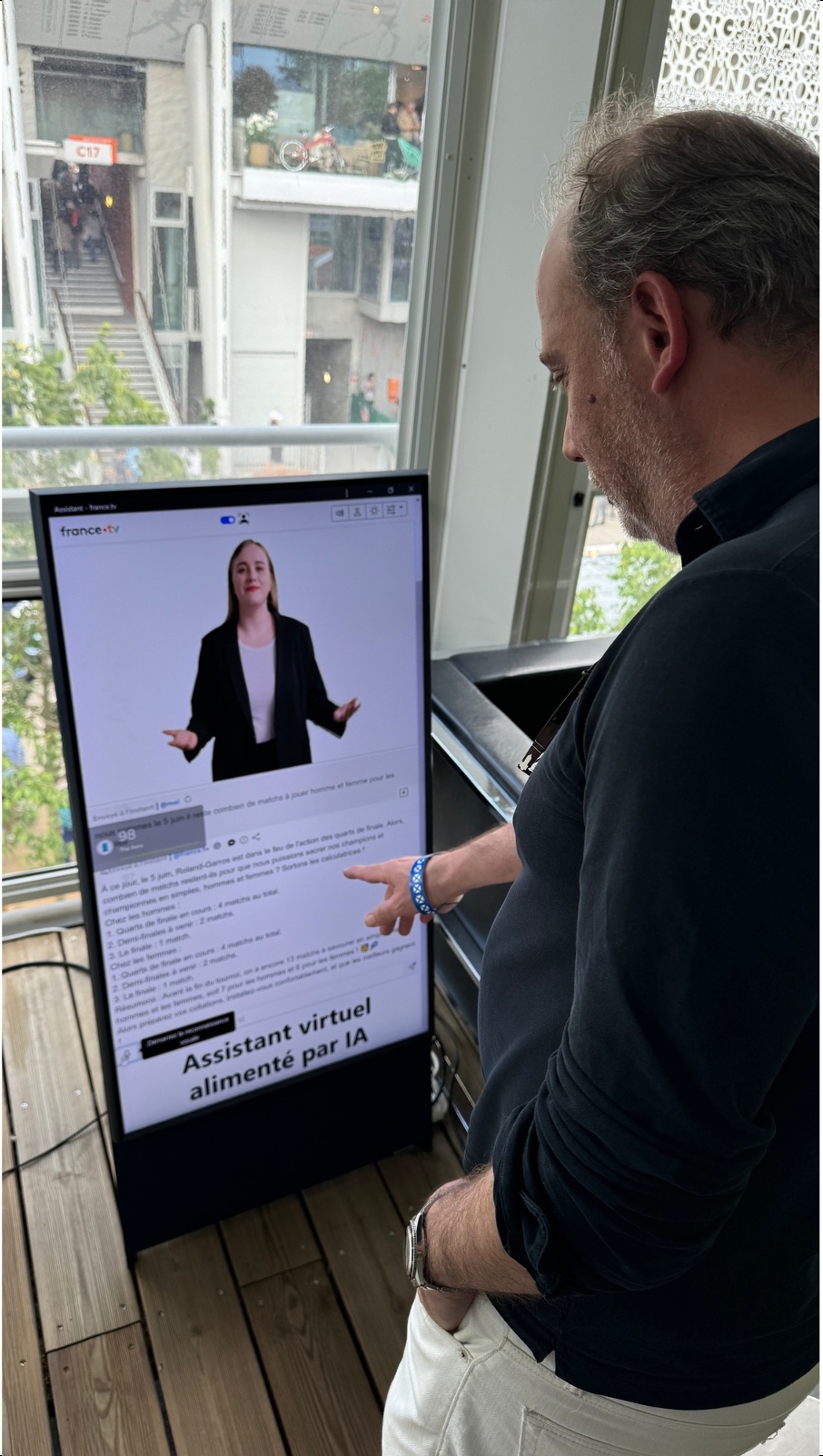
In the pursuit of research on artificial intelligence and avatars, the innovation department has developed a conversational agent in the form of a realistic video avatar, allowing it to answer questions about tennis and tournament news. This conversational agent is connected to various market LLMs and uses data from reference sites (franceinfo, FFT...).
How does it work?
Different technological components have been aggregated to create this video chatbot that allows users to interact and ask questions to a realistic avatar. A first "speech to text" component uses Whisper ASR (OpenAI) to transcribe the user's oral request into text that will feed the prompt sent to the selected LLM. Indeed, this demonstrator allows the selection of different market LLMs (ChatGPT, Gemini, Mistral, LLaMa, Claude, Palm2…) to test different response levels, including the relevance and speed of the responses sent.
To improve the quality of responses and the freshness of data, a RAG (Retrieval Augmented Generation) has been implemented within the demonstrator. This vector database allows the prompt to be enriched with recent and verified data from selected reference sites, enhancing the reliability of the LLM's responses. Depending on user requests, it can also query the FFT results database in real-time to supplement its responses to users.
The response formatted by the LLM according to the chosen criteria (response length, tone, language, etc.) is then sent to the HEYGEN platform, which converts the text response into speech and generates a photorealistic avatar video that is broadcast live to the user (via WebRTC).
The study of such a device allows us to explore various issues related to the use of these generative artificial intelligence technologies (costs, reliability, ethics, hallucination...) before considering the deployment of such a conversational agent within the digital services of France Télévisions that may express the need.

This prototype has been developed by the teams of the Digital Innovation Department of the public broadcaster, in collaboration with the French startup Cybronics.